New policy brief addresses the lag between biodiversity data collection and actionable biodiversity information
Biodiversity is enormously diverse, unevenly observed, and constantly in motion across space and time. This makes it far harder to monitor than many other parts of the environment. As a result, managing biodiversity often depends on information that is incomplete, delayed or unevenly distributed. At the very moment when rapid change makes timely knowledge more valuable, the systems for collecting, identifying, publishing and using biodiversity data often struggle to keep pace.
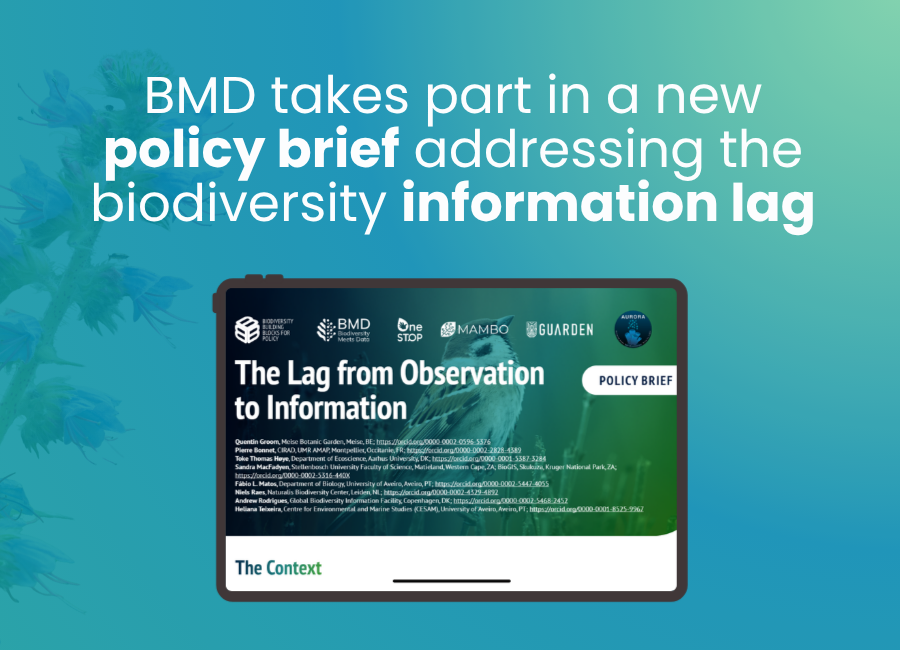
To address this, six European projects – BMD, B-Cubed, OneSTOP, MAMBO, GUARDEN, and AURORA – have developed a new policy brief suggesting five policy directions that can help mitigate the lag from biodiversity observation to information.
-
Reduce institutional bottlenecks: support data pipelines that move smoothly from field collection to open publication, with shared standards and automation where possible;
-
Rethink incentives: reward data publication and timely sharing as legitimate scientific outputs;
-
Strengthen identification capacity: invest in AI-assisted identification, reference collections and expert networks to accelerate taxonomic workflows;
-
Encourage near-real-time data use: develop platforms that deliver provisional but usable data for decision-making, with clear metadata on taxonomic uncertainty.
-
Embed feedback loops: Ensure that once information is used, results and corrections flow back to improve data quality over time.
The policy brief also provides examples of how the six EU projects aim to address the lag from observation to information. BMD is using high-throughput monitoring with camera traps, passive acoustic monitoring, and environmental DNA, coupled with AI species identification. The captured data is then uploaded to large open repositories, such as GBIF and OBIS, supporting the FAIR data principles. Alongside this, BMD is co-developing a suite of Biodiversity Analysis Tools for terrestrial, freshwater and marine systems, to help analyse the captured data. All of the collected information will be available in a single platform – the BMD Biodiversity Explorer, creating a more accessible way to work with biodiversity data.
Find out more about the issue and the future directions of each project in the policy brief available on Zenodo and our website.